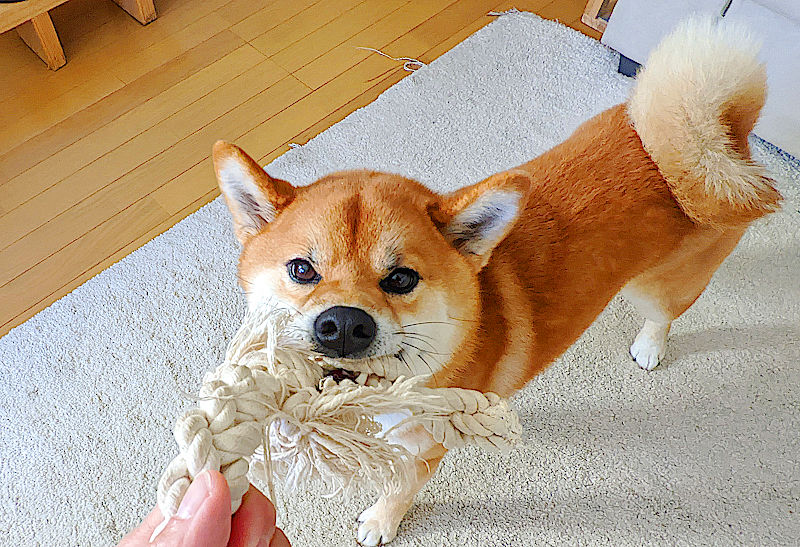
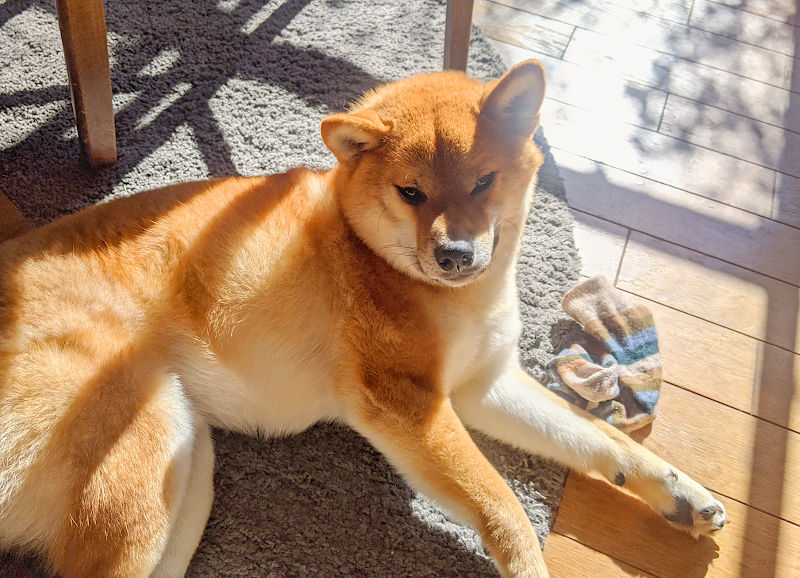
The well-grown “hair” is one of the characteristics of Shiba Inus. I have heard that many owners enjoy “Shiba sucking,” where they sniff and sniff the hair of their Shiba Inu.
The hair of a Shiba Inu, called “fur” is denser than that of other dogs, and you may not feel the unevenness of the skin when you touch it. Especially from the back of the head to the back and the root of the tail, there is probably so much hair that you can’t reach the skin even if you rake your fingers through it.
The coat that protects the Shiba Inu’s skin suddenly begins to shed without stopping, an incident that may come as a surprise to those who are not familiar with it, and is known as the “Shiba Inu’s shedding season”.
At the end of summer, my hair also begins to fall out, and my master says, “It’s finally here!” and in a sense, I welcomed the shedding season as if I were enjoying a poetic tradition. This time, I have compiled what I have learned about the shedding season and how we enjoy (?) it in my house. I hope you will enjoy this article.
What is the shedding season?

A simple explanation of the hair change season would be like a “change of clothes”.
The word “change of hair” is “change” in “exchange” and “hair” in “hair”, and refers to the “change of hair”, so the term “change of hair season” means “the time when hair grows back”.
Dogs other than Shiba Inu also have a molt, and cats, rabbits, deer, seals, and many other animals also have a shedding.
However, some dogs bred in warmer climates do not have a shedding season, or do not shed much hair to begin with. I guess so.
In fact, the coat itself seems to be constantly changing because of the “hair cycle,” but the shedding season seems to have a different purpose and is a time when the coat changes on a much larger scale.
The hair cycle takes a long period of time for the coat to grow and shed, whereas during the shedding season, the hair is shed and replaced all at once in a short period of time.
About “single coat” and “double coat” in dogs.

Dogs with only the overcoat are called “single coated” and those with both are called “double coated”. Dogs with only the overcoat are called “single-coated” and those with both are called “double-coated.
While humans usually have one or two hairs per pore, dogs have about 10 hairs per pore, and both the overcoat and undercoat hairs grow from the same single pore.
The overcoat is firm to protect the skin from external stimuli, while the undercoat is short, fine, and dense to retain heat and serve as waterproofing.
As can be seen from the difference between the overcoat and undercoat, single-coated dogs with only an overcoat tend to come from areas with strong UV rays and no need to keep their bodies warm, while dogs with a double coat tend to come from cold regions.
Japanese dogs such as Shiba and Akita are double-coated because they live in colder regions of the world!
Why is there a shedding season?

The purpose of the shedding season is “to adjust to the climate”.
Humans also change their clothing depending on the season, wearing short-sleeved, light clothing when it gets hot and long-sleeved, thick clothing when it gets cold, don’t they?
We Shiba Inus and other animals also adapt to a certain extent depending on the season, especially in summer and winter when the temperature is outside of the “comfortable climate” for survival.
It seems to be thought that sunlight and temperature, in addition to the hair cycle I mentioned earlier, have an effect on the shedding season.
This may be true of the natural world in general, as forests also turn red and leaves fall in autumn.
When is shedding season?
Shiba Inus generally have two shedding seasons a year. It may be easier to understand if you remember it as “before and after summer”.

It seems that the environment in which you live and the individual differences between dogs have a considerable impact on the number of shedding seasons. By the way, I feel that there are three shedding seasons a year.
This year (2023), I had a shedding season at the end of April and at the end of August. However, I think there was also a molt at the end of last year around December, so maybe the sheddin will start at the end of this year as well..!
About Puppy Coat

Shiba Inus have a thin “puppy coat” until they reach adulthood, during which time they do not have a shedding season. During the period from six months to less than 10 months of age, the hair does not change even if summer comes.
In my case, I was born in April and did not experience any particular shedding season until the end of that year. That being said, I remember my husband being surprised at the amount of hair that fell out the following spring!
How long does the shedding season last?
Once they enter the molt season, they continue to shed for a little less than 2 months in my case…! Generally, it seems to be said that it takes about a month, but since this also varies depending on the environment, breed, and individual, I would rather you just think, “Well, he will continue to shed for a while from now on”.
What to do during the shedding season?

The shedding season is a natural reaction of our Shiba Inus, so please do not think that you can fundamentally solve the problem = eliminate the shedding season…!
As I mentioned earlier, dogs start shedding based on their perception of seasonal changes in sunlight, temperature, humidity, etc. Therefore, if “light is provided for the same amount of time throughout the year” and “temperature and humidity are kept the same throughout the year,” or to use an analogy, if the environment is “well lit and air conditioned,” the shedding period may possibly be eliminated. In fact, the number of shedding seasons and the number of times the animal sheds its hair could be reduced.
In fact, the number of shedding seasons and the amount of hair that comes out seem to vary considerably depending on the environment in which the Shiba Inu spends its time. Especially recently, more and more Shiba Inus, including myself, are spending their time indoors, so it seems that their shedding season may be delayed because they spend their time in an air-conditioned environment. …I had a hair molt in December because the stove was warm, right?
So I think it would be easier if we could think of measures for “how to spend the molt season” rather than “how to eliminate the molt season” and expand our thoughts to “how to enjoy the molt season” like my husband did.
Measures to prevent hair loss in Shiba Inus
We Shiba Inus do not lose hair noticeably except during the molt season. If your Shiba Inu is shedding in large clumps even outside of the shedding season, it may be due to rough skin or stress, and you should have him checked by a doctor.
I pick up the loose hairs, vacuum them up, or use an adhesive roll cleaner called “Korokoro” to remove them.

As more hair falls out, it may fall out in clumps when the dog scratches its body with its hind legs, so brushing frequently to remove the loose hair before it falls to the floor makes cleaning easier.
As a means other than brushing, washing the dog’s body will remove the loose hairs, but since the dog will continue to shed until the molting season is over, it is indeed difficult to wash the dog’s body repeatedly, and repeated body washing will cause the skin and hair to lose the necessary oils, which can cause other problems.
Tools used for brushing during the molt season
Here are some of the tools I use to brush my husband during the molt season!
slicker brush
The first thing I would like to introduce is the slicker brush. It is said that the slicker brush is such an essential item that you can’t get through the molt season without it! I hear it is such an item that people think “I can’t get through the shedding season without a slicker brush”…! (according to my master).

A slicker brush differs from a regular brush in that it has many fine wire pins bent into the shape of the letter “<“.

This pin will take a lot of loose hair!
Since the pin is a wire, brushing it with force will damage the skin, so please be careful not to hit the skin when brushing and use it in a gentle way.
Comb
The next thing I would like to introduce is a comb.
In my husband’s case, rather than brushing with a comb, he seems to need a comb to remove loose hairs from his slicker brush.

My comb is made of metal with different pin spacing in the center.

I actually use the wide one quite a bit.
I will show you how to use a comb to get loose hairs from the slicker brush later in the brushing process!
Brush
We mainly use the regular brush when caring for their fur outside of the molt season. We have them use it for brushing to remove loose hair during the fur cycle and for removing debris and insects from their bodies in their daily lives.

My brush has a bristled backside, which seems to be for making the overcoat hair shiny (I don’t use it much…).

FURminator
I also have a furminator as a tool to remove loose hair. However, I do not use it very often because it is more of a hair cutter than a hair remover.

The farminator has teeth on the end, and at a quick glance, it looks like a clipper.

The fine teeth grab the hair and cut it, removing not only the undercoat but also the overcoat, so I refrain from using the furminator because overdoing it weakens the skin’s ability to protect itself from UV rays and other irritants…!
Kong
It is not directly related to brushing, but I recently started using it and my husband was very impressed with it. The Kong is originally a tool for eating treats while playing with it.
Kongs are originally used for eating treats while playing, and can be found in the toy section of pet supply stores.


As I will show you later in the brush method, my master put treats in the Kong and while I am engrossed in it, my master does the brushing.
It seems to be a good idea for dogs that don’t like to be brushed!
How to brush your Shiba Inu during the shedding season.
Let me show you the brushing method I have them do during the shedding season! First, let me write down the order.
- Prepare treats
- Remove collars and other items worn
- Attract attention with treats
- Brush with a slicker brush.
- Remove hair from the slicker brush with a comb
- Repeat steps 3 to 5
1. Prepare treats
First, prepare treats. I am a dog who does not like brushing without treats, so my master prepares treats before anything else to attract my attention.


Have the jerky shredded and stuffed into a Kong and you are ready to go.
2. Remove collars and other items worn
Remove all collars and other items as the entire body is brushed.

In my case, by providing a treat before taking the collar, I can hold still without being uncomfortable.
3. Attract attention with treats
My master brings the treat in the Kong close to my face to get my attention.
I will then take advantage of the opportunity to reach out with my tongue for the treats in the Kong!
Keep the Kong in one hand and the slicker brush in the other.

4. Brush with a slicker brush.
While my mind is on the Kong treats, I get a slicker brush to brush them with.

My master ran the slicker brush over the body in a direction that went against the hairline and immediately removed a lot of loose hair!
5. Use a comb to remove hair from the slicker brush.
During the shedding season, just 3 to 4 times of slicker brushing will remove a lot of hair, and the slicker brush will be covered with a lot of loose hair.
When the slicker brush is full of hair, no matter how many times you use it, it will be meaningless.


Insert a comb through the end of the slicker brush and slightly wiggle it from the base of the slicker brush pins to remove tangled loose hairs.

Any loose hairs from the slicker brush can be discarded as is!
6. Repeat 3-5.
Brushes are applied all over the body while distracting them with treats.

Please try to brush with a balance of left and right sides, back, neck, etc. so as not to be biased.

This is about how much I was able to remove in one brush stroke (one day). I think I could have removed more if I brushed more carefully, but I finished today at a certain point, considering the burden on the skin and not to feed them too many treats.

By the way, here is the amount of hairs removed as a result of a month of brushing..!

Summary
What do you think about the various aspects of the Shiba Inu’s shedding season?

There may be various reasons for wanting to stop the shedding somehow, or for the difficulty of cleaning up the loose hairs, but I would be happy if you could enjoy brushing your Shiba Inu, thinking of the shedding of hair as a seasonal event, just like the beautiful fall foliage that the overgrown plants in the summer show in the fall!